Understanding Load Bank Testing for Generators and Power Systems
Load bank testing is a critical process used to evaluate the performance, reliability, and safety of generators, uninterruptible power supplies (UPS), and other electrical power systems before they are deployed in real-world applications. Whether it’s for factory acceptance testing (FAT), commissioning, or routine maintenance, load banks simulate real-world electrical loads to ensure that equipment can handle expected power demands without failure. This article provides a comprehensive technical overview of load bank types—resistive, reactive, capacitive, and combination (RLC)—and explains how each type supports different testing scenarios across industries such as data centers, hospitals, oil & gas, and renewable energy projects.
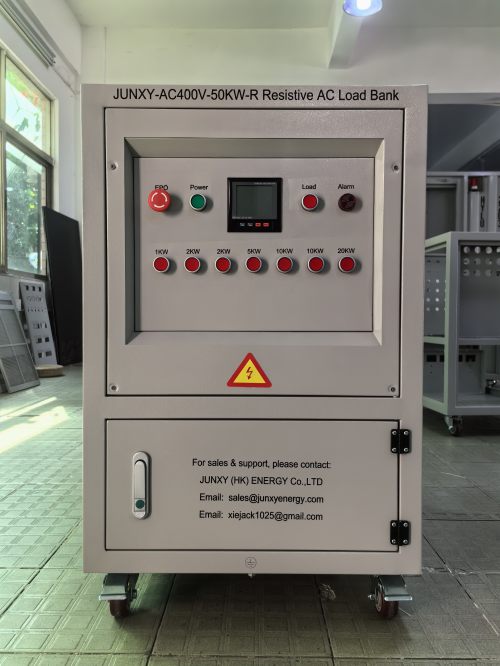
A resistive load bank is the most common type and functions by converting electrical energy into heat using precision resistor blocks. It simulates purely real power (kW) consumption, making it ideal for verifying generator output capacity, fuel efficiency, and cooling system effectiveness. These units typically operate at unity power factor (PF = 1.0), meaning all current drawn is used to do useful work. For example, a 500 kW resistive load bank can be used to test a diesel generator rated at 600 kVA to confirm it can sustain full-load operation under various ambient conditions. According to IEC 60034-1, which defines standard methods for testing rotating electrical machines, load bank tests must replicate actual operating conditions to validate thermal stability and mechanical integrity over time. In one anonymized case study from a U.S. data center project, a 1 MW resistive load bank was employed during FAT to verify that the backup generator could maintain stable voltage and frequency for four hours at 100% load—critical for ensuring uninterrupted server operations during outages.
Reactive load banks, on the other hand, introduce inductive or capacitive reactance into the circuit, allowing engineers to test the generator's ability to manage reactive power (kVAR). Inductive loads mimic motors, transformers, and industrial machinery, while capacitive loads simulate modern electronics with high power factor correction. Reactive testing helps assess excitation system performance, voltage regulation, and harmonic distortion mitigation capabilities. IEEE Standard 1159 addresses power quality issues related to reactive loading, particularly in environments where nonlinear loads are prevalent. A simulated example from an offshore wind farm installation shows how a 200 kVA reactive load bank helped fine-tune the control settings of a 500 kW diesel generator serving as a backup source, reducing voltage fluctuations from ±5% to within ±2%, thereby improving grid compatibility.
Combination (RLC) load banks integrate both resistive and reactive components, enabling full-spectrum testing that includes active power (kW), reactive power (kVAR), and apparent power (kVA). These versatile systems allow for dynamic adjustment of power factor between 0.1 and 1.0, supporting complex scenarios like testing microgrids or hybrid energy storage systems. RLC load banks are often preferred in military, aviation, and telecom sectors where equipment must perform reliably under fluctuating load profiles. One notable application involved a 3-phase 500 kVA RLC load bank used in a remote Arctic research station to test a solar-diesel hybrid system’s ability to transition smoothly between modes without blackouts—an essential requirement given the region’s extreme weather and limited access to external power sources.
Portable load banks offer mobility for field testing, especially in locations where permanent installations aren't feasible. Typically designed with robust enclosures (IP54 rating), integrated lifting eyes, and fork-lift pockets, these units support easy transport and setup. They often feature remote monitoring via Ethernet, Modbus RTU, or CAN bus protocols, allowing technicians to adjust load levels without physical proximity—a significant advantage in hazardous environments. The European EN 61010-1 standard governs safety requirements for electrical measuring equipment, including load banks, mandating proper grounding, short-circuit protection, and emergency stop mechanisms. In a recent case involving a hospital in Southeast Asia, a portable 300 kW resistive load bank enabled rapid commissioning of a new backup generator after a natural disaster disrupted normal operations—demonstrating the importance of flexibility in emergency response planning.
Thermal management is another key consideration when designing or selecting a load bank. Resistive elements generate substantial heat, necessitating efficient air or water cooling systems. Air-cooled models rely on forced convection fans, while water-cooled units transfer heat through a closed-loop fluid system. Cooling design directly impacts maximum continuous load duration and overall lifespan. For instance, a 500 kW resistive load bank with air cooling might be rated for 60 minutes at full load, whereas a water-cooled version may support up to 240 minutes due to superior heat dissipation. Thermal protection circuits—including temperature sensors, automatic shutdown, and alarm triggers—are essential for preventing overheating and fire hazards. Industry best practices recommend annual calibration of measurement instruments (voltage, current, power, PF) to maintain accuracy within ±1% per ANSI/IEEE C59.6 standards.
Electrical parameters such as voltage range, phase configuration, and power factor adjustment range define a load bank’s versatility. Single-phase and three-phase configurations are widely available, with typical voltage ranges spanning from 120 VAC to 600 VAC. Most modern load banks offer adjustable power factors from 0.1 (highly inductive) to 1.0 (purely resistive), enabling precise emulation of diverse load profiles. Communication interfaces like RS-485, Modbus TCP/IP, and Ethernet facilitate integration with SCADA systems and cloud-based monitoring platforms, enhancing operational visibility and predictive maintenance capabilities. For example, a utility-scale battery storage facility in Germany uses a 1 MVA RLC load bank connected to a central control system to simulate daily charging/discharging cycles, optimizing battery health and extending service life.
Maintenance and calibration are crucial for long-term reliability. Resistor blocks, fans, and contactors require periodic inspection and replacement based on usage intensity. As a general rule, fan assemblies should be replaced every 3–5 years, depending on dust exposure, while resistor blocks have lifespans exceeding 10 years if operated within their thermal limits. Calibration intervals vary by manufacturer but typically fall between 6–12 months. Recommended spare parts include fuses, relay modules, temperature probes, and cooling fans. Proper documentation of test results—including voltage stability, harmonic content, and load step responses—is vital for compliance with regulatory bodies like OSHA and local electrical codes.
In conclusion, load bank testing serves as a cornerstone of electrical system validation across multiple sectors. By simulating realistic load conditions, engineers gain confidence in equipment performance, reduce downtime risks, and comply with international standards. Whether choosing a fixed resistive unit for routine checks or a portable RLC system for field deployments, selecting the right load bank requires understanding both technical specifications and application-specific needs. With advancements in digital control, remote diagnostics, and thermal modeling, load banks continue to evolve into intelligent tools that enhance power system resilience and operational excellence.